01 · A research agenda for the behavioral sciences

GenerativeImmersion

Generative immersion places people inside situations that AI has generated: scenes, people and events made by video and world models rather than filmed on location or modeled by hand. For the behavioral sciences, it turns the immersive scenario into something you can write, vary and share.

Initiated by Ranran Li & Botao Amber Hu · 2026

02 · Technology

What the models make now

Two lines of development meet here. Video models now hold a scene together over long continuous shots, with sound. World models turn a prompt or a photo into a space you can move through.

Scroll sideways through the strands, and down within each one.Scroll down within each strand.

01

AI video generation

The same people, the same place and synchronized sound, held together across long continuous shots.

Seedance 2.5ByteDance SeedJul 2026one 30-second take from a text prompt, with sound

Seedance 2.5 generates up to 30 seconds of video and sound in a single pass, and extends a scene round after round while keeping its characters and setting. It can draw on up to 30 images, 10 video clips and 10 audio clips at once, and on untextured 3D renders that fix the blocking and the camera path.

Edits can target a single timestamp, the camera move or a green-screen background, while the rest of the scene stays as it was.

For researchKeeping everything constant while one element changes is the logic of an experimental manipulation.

More from the same release

Extensiona scene carried on with the same characters, 65 s
Clay-render referencea rough 3D layout sets camera and blocking, 31 s
02

World generation

From scenes you watch to spaces you move through: generated as you explore, or built once and kept.

Genie 3Google DeepMindAug 2025

Genie 3 generates a world from a text prompt in real time, at 720p and 24 frames per second, as you move through it, and keeps it consistent for several minutes. Text prompts can change the world on the way: the weather turns, a person appears. Since January 2026, Project Genie lets Google AI Ultra subscribers create such worlds and explore them for 60 seconds at a time.

MarbleWorld LabsNov 2025

Marble builds persistent worlds from text, photos, video or a rough 3D layout. They can be edited and combined, then exported as Gaussian splats or meshes, for example into a game engine.

For researchA world that keeps generating can respond to what a participant does, not only show what everyone should see.

Also moving

  • Tencent · Apr 2026 · openHY-World 2.0 generates or reconstructs editable 3D worlds from text, images or video, as meshes or Gaussian splats.
  • Meta Reality Labs · Nov 2025 · researchWorldGen builds traversable, interactive 3D worlds from a single text prompt.
  • ByteDance · 2026 · not releasedA real-time world model built on Seedance and aimed at Pico headsets, reported in September and first shown in October 2026.

03 · Ongoing research

Ongoing research

A perspective paper that maps the field, and two studies that put generated scenarios to work: one tests whether they hold up as research stimuli, the other lets a scenario respond to what participants do.

Perspective paper · in preparation

Generative Immersion for behavioral sciences: A scoping review, position, and research agenda

Authors and venue to be confirmed. The preprint will appear here.

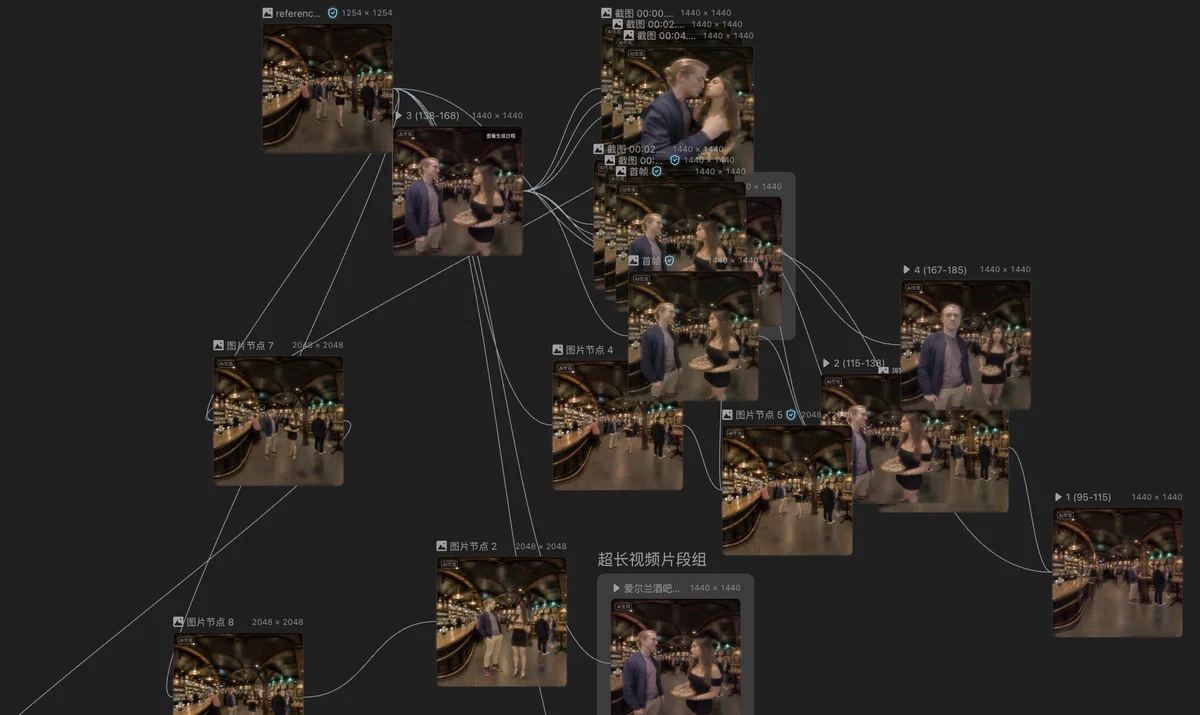
Node canvas of AI-generated 360-degree scenes of an Irish pub: a reference image, image nodes and video segments linked by lines

Ongoing · validation study

Scalable Immersion

Validating AI-generated video scenarios

Can an AI-generated scenario stand in for a filmed one? We take an established bystander scenario from the MAXLab scenario set, in which a guest in an Irish pub is harassed and others can step in, and generate it anew with video models. Written, filmed and generated versions of the same incident are compared on presence, perceived realism and the emotions they evoke.

Related publications

How a generative enactment unfolds A generated clip shows a scene. The participant acts: step in, call for help, or look away. Each choice leads to a different continuation (the harasser backs off, help arrives, or it goes on), and the next clip is generated from that response. Every choice is logged. 01 · THE SCENE 02 · YOU ACT 03 · IT RESPONDS a generated clip Step in Call for help Look away every choice is logged BACKS OFF HELP ARRIVES IT GOES ON the next clip is generated from the response

Ongoing · method development

Generative Enactments

Action-contingent reactive video scenarios for behavioral science research

Most scenario studies are linear: everyone watches the same clip, then says what they would do. Generative enactments let the scenario respond. What a participant does, such as stepping in, calling for help or looking away, decides how the scene continues, and the next clip is generated for that choice. People meet the consequences of their own actions, and every choice becomes behavioral data.

Related publications

Where to publish Journal outlets for Generative Immersion 42 journals compared by standing, impact factor and the kinds of papers they take.

04 · Promise

What it could do for behavioral science

Immersive scenarios already let researchers study behavior in situations that are hard to observe or to stage. Generating them changes what such studies can do.

01

Situations you cannot stage

Violence, emergencies and places that do not exist yet are unethical, dangerous or impossible to film. Generated scenarios bring people into them and record how they respond.A fight breaking out in a crowded bar, seen through a bystander's eyes.

02

Control without giving up realism

Experiments usually trade realism for control. A generated scene can hold everything constant and change a single cue: a gesture, a line of dialogue, the lighting.The same pub, the same quarrel; only whether the victim calls for help changes.

03

Many situations, not one

A variant that once needed a new shoot now takes a new prompt. Studies can sample situations as carefully as they sample people, and adapt scenes across languages and cultures.Fifty street encounters, drawn like items for a scale.

04

Behavior, not only reports

Inside a scenario people act rather than predict how they would act. Where they look, when they step in and which way they turn all become data.Where people look in the seconds before they decide to intervene.

05

Futures you can test

Policies, technologies and places that do not exist yet can be generated and tried out before they are built, in the spirit of science fiction science.A station where a camera can call the police, before such stations exist.

06

Shared and rebuilt

Prompts, references, seeds and model versions can travel with a paper, so that other labs can rebuild the stimulus, extend it and replicate the study.A stimulus that ships with its recipe.

And what has to hold

Generated is not yet valid.

A generated scene still has to evoke the responses that matter, and generated content should be disclosed to participants and readers. Models also change fast, which puts reproducibility at risk. We treat these as research questions in their own right.

Background

05 · People & connect

Promoters

Write to us about collaborations, studies or talks.

Ranran Li

Humboldt Research Fellow

Psychology is forever moonlight; interdisciplinarity by heart.

r.li@csl.mpg.de

Department of Criminology

Max Planck Institute for the Study of Crime, Security, and Law

Freiburg im Breisgau, Germany

ranranli.net ↗

Collaborators

Jean-Louis van Gelder Director, Max Planck Institute for the Study of Crime, Security and Law
Misha Sra University of California, Santa Barbara University of Oxford
To be announced The network is growing. Get in touch if you would like to join.